Commercial Roof Installation Services in Georgia: What Business Owners Need to Know
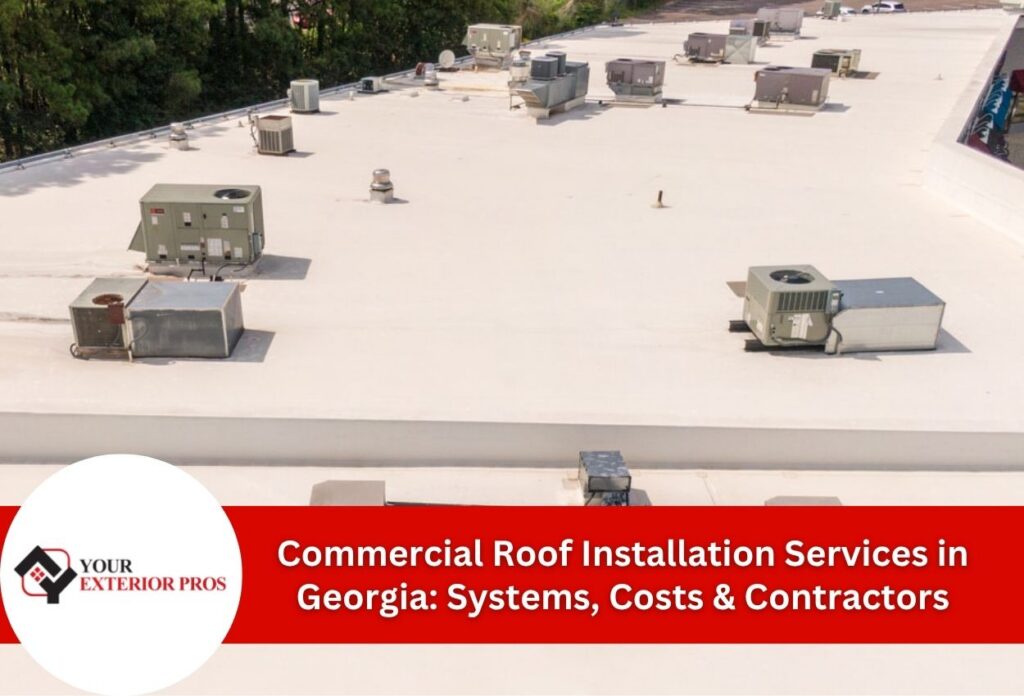

Commercial roof installation in Georgia covers new construction installs, full system replacements, and material-specific builds for low-slope and steep-slope commercial structures including TPO, EPDM, modified bitumen, metal, and built-up roofing systems. These services apply to a wide range of property types, from warehouses and retail centers to office parks, apartment complexes, and industrial facilities.
Georgia’s humid climate puts real stress on commercial roofs. Annual rainfall across the state typically ranges from 45 to 55 inches, and summer temperatures commonly reach the low 90s. That combination of heat, humidity, and frequent thunderstorms accelerates wear on membranes, seams, and flashings faster than in drier climates. The right roofing system and the right installation method make a measurable difference in how long a roof holds up.
Business owners and general contractors evaluating a commercial roofing project need to weigh several factors: which roofing system fits the building type, what local code compliance requires, how contractor licensing affects accountability, and what the full project scale and costs look like. Each of those decisions affects long-term performance.
This article covers all of it: system types, costs, code requirements, contractor selection, and what to expect during installation. Jump to the section most relevant to your project or read through from start to finish.
What Types of Commercial Roofing Systems Are Installed in Georgia?
Low-slope and flat roofing systems dominate Georgia’s commercial market, with TPO, EPDM, PVC, modified bitumen, built-up roofing, and commercial metal roofing systems each serving different building types, budgets, and performance needs.
| System Type | Slope Compatibility | Typical Lifespan | Best Use Case | Georgia Climate Suitability |
|---|---|---|---|---|
| TPO | Low-slope (1/4:12 to 2:12) | 20 to 30 years | Warehouses, retail centers, office parks | Highly reflective surface reduces heat gain |
| PVC | Low-slope (1/4:12 to 2:12) | 20 to 30 years | Restaurants, buildings with grease exposure | High: chemical-resistant, reflective membrane |
| EPDM | Low-slope (1/4:12 to 2:12) | 20 to 25 years | Office buildings, apartment complexes | Moderate: absorbs heat; dark membrane adds cooling stress |
| Modified Bitumen | Low-slope (1/4:12 to 2:12) | 15 to 20 years | Older commercial buildings, reroofing projects | Moderate: common on legacy Georgia properties |
| Built-Up Roofing (BUR) | Low-slope (1/4:12 to 2:12) | 15 to 30 years | Industrial facilities, high-traffic roof areas | Moderately durable but heavy; slower to install |
| Commercial Metal | Low-slope to steep (1/4:12+) | 30 to 50 years | Industrial, mixed-use, distribution facilities | High: strong wind resistance, long service life |
Low-slope systems dominate Georgia commercial construction because these buildings need large, uninterrupted roof surfaces to house HVAC equipment, accommodate drainage systems, and cover wide floor plans without interior support columns. Older commercial properties across Georgia, especially those built before the 2000s, commonly have built-up roofing, modified bitumen roofing, or older single-ply systems still in service. Newer construction in metro Atlanta and growing corridors like Gwinnett County, Forsyth County, and along Interstate 85 and Interstate 285 more often uses TPO, PVC, and standing seam metal roofing systems.
Reflective membranes like TPO and PVC are increasingly the first choice on large commercial buildings in Georgia because they reduce heat absorption during summer temperatures that regularly reach the low 90s Fahrenheit, a direct energy management advantage over traditional dark-surface systems like standard black EPDM, though white EPDM products and ballasted configurations are available to achieve similar reflective benefits. Commercial metal roofing systems stand apart in industrial and mixed-use settings where a 30 to 50 year lifespan justifies the higher upfront installation cost.
How Does Georgia’s Climate Affect Commercial Roof Installation Decisions?
Georgia’s annual precipitation, which ranges from 45 inches centrally to 75 inches in the mountains, alongside summer temperatures regularly reaching the low 90s Fahrenheit, and high year-round humidity create a combination of stress factors that directly shape which roofing systems contractors recommend and when they schedule installation work. No single climate factor operates alone; heat, moisture, and storm exposure add to each other, accelerating wear on membranes, seams, and flashings faster than in drier or cooler markets. Material selection and installation timing both have to account for these conditions before a single fastener goes in.
- UV exposure and heat: Intense summer sun degrades roofing membranes over time, causing expansion and contraction stress, especially on metal panels and dark-surface systems like standard EPDM. Metro Atlanta’s heat island effect amplifies this, pushing thermal stress beyond what standard regional data might suggest.
- High annual precipitation: At 45 to 55 inches per year, Georgia’s rainfall accelerates seam separation and flashing wear. Heavy rainstorms also raise the risk of ponding water on low-slope roofs, which strains membrane seams and drainage systems sized too small for peak flow.
- Humidity and sealant aging: Persistent moisture throughout the year, especially in summer, speeds up sealant breakdown around gaps, drains, and edge metal, raising the risk of a leak on buildings that are not re-inspected regularly.
- Storm-related wind uplift and hail: Spring and summer severe weather brings the highest exposure to high winds, hail, and tornadoes. Wind uplift stress on membrane edges and field seams is a documented installation consideration, particularly on large low-slope commercial roofs.
- Regional variation: Northern Georgia sees occasional cold temperatures that can affect adhesive bonding and moisture-sensitive detailing steps. Coastal Georgia faces higher wind and rain from tropical systems, requiring stricter attention to edge-metal and flashing details.
These climate factors directly influence material selection: reflective membranes like TPO and PVC perform better under Georgia’s heat stress, while drainage system sizing and seam detailing decisions must account for the 45 to 55-inch annual rainfall range.
What Roofing System Is Best for Flat and Low-Slope Commercial Buildings in Georgia?
The right flat or low-slope roofing system depends on at least 6 variables, and no single system is the right answer for every Georgia commercial building. Run through each factor below before committing to a material or contractor bid.
- Building age and underlayment condition: Older buildings with deteriorated or uneven roof decking often perform best with modified bitumen, which conforms well to irregular surfaces and tolerates underlayment imperfections that would compromise a mechanically attached TPO or PVC system.
- Roof pitch and drainage design: While new construction requires a minimum 1/4:12 pitch, reroofing projects must achieve positive drainage, and roofs below this threshold with existing drainage problems are highest risk for ponding. TPO and PVC with heat-welded seams handle standing water better than modified bitumen, which relies on lap seams that can separate under prolonged water exposure.
- Occupancy type and foot traffic: Roofs with regular foot traffic near rooftop HVAC equipment, grease exhaust vents, or other mechanical gaps need reinforced puncture resistance. Modified bitumen and built-up roofing systems, which can reach 15 to 30 years of service life, are better suited to high-traffic zones than standard single-ply membranes.
- Energy efficiency goals: Buildings targeting lower cooling costs during Georgia summers that regularly reach the low 90s Fahrenheit should prioritize commercial TPO roofing. Both are reflective membranes that reduce heat gain and can support ENERGY STAR compliance on large commercial roofs.
- Budget tier: EPDM remains the most budget-accessible option for retrofits on older underlayment, with a typical lifespan of 20 to 25 years. TPO and PVC carry higher upfront costs but often lower long-term maintenance costs in Georgia’s high-heat environment.
- Anticipated maintenance commitment: Property owners who prefer low-touch maintenance between inspections are better served by heat-welded single-ply systems like TPO or PVC. Modified bitumen and built-up roofing systems require more frequent seam and flashing checks, especially given Georgia’s 45 to 55 inches of annual rainfall.
No decision checklist replaces a site assessment. A licensed commercial roofing contractor in Georgia should inspect the existing underlayment, drainage layout, and roof slope before any final system selection is made. Your Exterior Pros offers on-site evaluations to match the right system to the actual conditions of the building, not just a general category.
What Is the Commercial Roof Installation Process From Start to Finish?
A commercial roof installation typically spans 1 to 2 weeks for smaller buildings under 10,000 sq ft, 3 to 6 weeks for mid-size projects between 10,000 and 50,000 sq ft, and 8 to 16+ weeks for large-scale or new construction work above 50,000 sq ft. The full process runs through roughly 10 distinct phases, each one building on the last. Skipping or rushing any phase, especially underlayment preparation or flashing detailing, is one of the most common causes of early system failure on Georgia commercial roofs.
- Initial site assessment and roof survey: A contractor inspects the existing roof surface, underlayment condition, slope, drainage layout, and gap count before any pricing or planning begins.
- Scale of work development: The assessment drives a written job scale that defines tear-off versus recover, material selection, drainage modifications, and phasing requirements for occupied buildings.
- Permitting and code compliance review: Georgia building codes require permits for most commercial roof replacements. This step addresses local jurisdiction requirements, wind uplift ratings, and fire classification standards before procurement begins.
- Material procurement: Lead times vary by system. TPO and EPDM rolls are generally available within 1 to 2 weeks, while custom metal panels or specialty flashings can add time to the schedule.
- Tear-off or recover evaluation: The contractor determines whether the existing system must be removed or whether a recover is code-permissible and structurally sound. Georgia allows a maximum of two roof layers on most commercial roof decks before a full tear-off is required.
- Underlayment preparation: The roof deck is inspected and repaired, insulation is installed or replaced, and the surface is cleared and dried before any membrane goes down.
- System installation: The primary roofing membrane TPO, PVC, EPDM, modified bitumen, built-up roofing, or metal is installed according to manufacturer specifications and local wind uplift requirements.
- Flashing and gap detailing: All edges, curbs, HVAC equipment bases, drains, and roof gaps are flashed and sealed. This phase is where most leak points originate if shortcuts are taken.
- Drainage inspection: Drains, scuppers, and downspouts are checked to confirm flow capacity matches the roof’s drainage design, accounting for Georgia’s peak rainfall seasons.
- Final quality walkthrough and project closeout documentation: The contractor conducts a full inspection, documents completed work, and delivers warranties, inspection reports, and any required code compliance certificates.
| Phase | Small Commercial (under 10,000 sq ft) | Mid-Size Commercial (10,000 to 50,000 sq ft) | Large-Scale / New Construction (50,000+ sq ft) |
|---|---|---|---|
| Assessment & Job Scale | 1 to 2 days | 2 to 5 days | 1 to 2 weeks |
| Permitting | 3 to 7 days | 1 to 2 weeks | 2 to 4 weeks |
| Procurement | 3 to 7 days | 1 to 2 weeks | 2 to 4 weeks |
| Tear-Off / Underlayment Prep | 1 to 2 days | 3 to 7 days | 1 to 3 weeks |
| System Installation | 2 to 4 days | 1 to 3 weeks | 4 to 10 weeks |
| Flashing & Detailing | 1 day | 2 to 4 days | 1 to 2 weeks |
| Inspection & Closeout | 1 day | 1 to 2 days | 3 to 5 days |
Georgia’s weather directly affects how these timelines play out in practice. Rain delays, high-wind days, and summer heat that regularly reaches the low 90s Fahrenheit can interrupt installation sequences at any phase, and any exposed underlayment must be protected from leaks overnight or between work sessions.
Multi-day projects on occupied commercial properties require coordination with building occupants, HVAC contractors, and drainage system inspectors to allow phased installation and keep disruption to a minimum. Realistic scheduling accounts for at least a few weather-related interruptions during any project that runs longer than 1 week in Georgia.
What Does Commercial Roof Installation Cost in Georgia?
Installed costs for commercial roofing in Georgia range from roughly $4.50 to $18.00 per square foot depending on the system type, with a 20,000 sq ft project typically falling between $90,000 and $360,000 across all system categories. The table below breaks down cost ranges by system type to give property owners a starting benchmark before requesting contractor bids.
| Roofing System | Installed Cost Per Sq Ft (Low) | Installed Cost Per Sq Ft (High) | Typical Total Cost 20,000 Sq Ft Roof | Cost Tier |
|---|---|---|---|---|
| EPDM | $4.50 | $8.00 | $90,000 to $160,000 | Budget |
| Modified Bitumen | $5.00 | $9.00 | $100,000 to $180,000 | Budget to Mid-Range |
| Built-Up Roofing (BUR) | $5.50 | $10.00 | $110,000 to $200,000 | Mid-Range |
| TPO | $6.00 | $10.50 | $120,000 to $210,000 | Mid-Range |
| PVC | $7.00 | $12.00 | $140,000 to $240,000 | Mid-Range to Premium |
| Metal (Standing Seam / Engineered) | $10.00 | $18.00 | $200,000 to $360,000 | Premium |
Several variables push a project toward the high end of any range. Roof size and complexity, roof deck condition, required tear-off, material grade, and contractor experience tier all affect final costs. Permitting and engineering fees add to the total, and labor rates differ between metro Atlanta, suburban markets, and rural Georgia; metro projects often run 10% to 15% higher on labor alone. A full tear-off on a building with two existing roof layers, the maximum typically allowed under Georgia code before removal is required, can add $1.50 to $3.00 per square foot to the base installation cost.
Property owners looking for affordable commercial roof installation costs in Georgia have several practical options. A recover over an existing system, where code and underlayment condition allow, can reduce costs compared to a full commercial roof replacement. Getting competitive bids from at least three licensed contractors helps establish a true market rate for the specific project. Manufacturer warranty programs from TPO and PVC suppliers often cover labor and materials for 15 to 20 years, which offsets long-term maintenance costs and makes higher upfront system costs more justifiable over time. Phased installation across budget cycles is another option for larger properties.
Insurance claims and financing are also worth factoring in. Storm damage from hail or high winds, both common in Georgia’s spring and summer severe weather season, may qualify as part of a replacement for a covered insurance claim, reducing out-of-pocket project costs. Some commercial roofing contractors offer financing arrangements for larger projects. The most reliable way to establish accurate, project-specific pricing is to request a free estimate from Your Exterior Pros, which accounts for actual roof conditions, local permit requirements, and current material costs rather than a generic per-square-foot average.
What Are the Licensing and Insurance Requirements for Commercial Roofing Contractors in Georgia?
Georgia requires commercial roofing contractors to hold a license through the Georgia State Licensing Board for Residential and General Contractors, with most commercial roofing work falling under either the General Contractor classification or exempt specialty trade categories, depending on the project’s scale and contract value. This distinction matters to property owners because the license class determines what type and size of commercial job a contractor is legally authorized to perform. A General Contractor license covers larger commercial projects. In contrast, standalone roofing on light commercial structures may only require local permits, so asking how a bidder’s classification aligns with your project scale is a reasonable and worthwhile question before signing any contract.
Insurance Coverage Property Owners Should Verify
General liability insurance and workers’ compensation are the two most important policies to verify before work begins on any commercial roofing project. For commercial-scale projects, while the state minimum for a General Contractor is $500,000, general liability coverage of at least $1,000,000 per occurrence is a standard minimum threshold, and many building owners and property managers require higher limits, often $2,000,000 or more before allowing work to proceed. Under Georgia law, workers’ compensation insurance must cover businesses with three or more employees, though property owners should require it for every crew member on site, not just the contractor’s direct employees.
Subcontractors who lack their own coverage can create liability exposure for the property owner if an injury occurs. Some larger commercial contracts also require a surety bond, which provides financial protection if a contractor fails to complete the work or meet contractual obligations. Always request a certificate of insurance directly from the contractor’s insurer, not just a copy handed over by the contractor, so coverage dates and limits can be confirmed as current.
Permits, Inspections, and the Risk of Unpermitted Work
Georgia building codes require permits for most commercial roof replacements, and the licensed contractor pulling the permit is responsible for scheduling inspections at required phases of the project. Skipping this step creates real problems. Unpermitted commercial roofing work can result in code violation notices, fines, and a requirement to remove and redo the installation at the property owner’s cost. Manufacturer warranties are also at risk; most commercial membrane manufacturers require permit documentation and passing inspections as a condition of warranty coverage.
Any reputable licensed commercial roofing contractor in Georgia will pull permits without hesitation and walk property owners through the inspection process. If a contractor proposes skipping permits to cut costs or speed up the timeline, that is a clear signal to keep looking.
Your Exterior Pros provides full license and insurance documentation as a standard part of the bidding process, no prompting required.
How Do You Evaluate and Compare Commercial Roofing Companies in Georgia?
Start by verifying a contractor’s Georgia license classification, insurance certificates, and manufacturer certifications before reviewing a single bid; those three items alone eliminate most unqualified contractors. Georgia’s commercial roofing market includes well-established specialists and high-volume contractors whose quality varies widely, so a structured checklist is the fastest way to separate them.
- License verification: Confirm the contractor holds the correct Georgia State Licensing Board classification for the project scale and contract value. A Specialty Contractor license has limits; larger commercial replacements require a General Contractor classification.
- Insurance confirmation: Request a certificate of insurance directly from the insurer showing general liability coverage of at least $1,000,000 per occurrence and workers’ compensation covering all crew members on site, including subcontractors.
- Commercial-specific experience: Ask how many years the contractor has focused on commercial work, not combined residential and commercial. Job scale management, commercial building code knowledge, crew size, and equipment for phased installation on occupied buildings are skills that do not transfer automatically from residential projects.
- Local project portfolio: Request references from comparable Georgia commercial properties with a similar building type, roof size, and system installed within the last three to 5 years. Metro Atlanta and suburban Georgia markets both have active commercial roofing activity, so verifiable local references should not be difficult to produce.
- Warranty terms in writing: Get all warranty details in a written contract: system type, coverage period, what triggers a claim, and who performs repairs. Verbal warranty commitments are unenforceable.
Red Flags When Vetting Contractors
- No verifiable Georgia license: Any contractor unable to provide a license number for immediate verification through the Georgia State Licensing Board should be removed from consideration.
- Pressure to skip permits: Unpermitted commercial roofing work risks code violations, fines, mandatory removal, and voided manufacturer warranties. A reputable contractor pulls permits without hesitation.
- Unusually low bids: Bids that come in 20% or more below the field often exclude tear-off costs, insulation, flashing replacement, or other line items that will surface as change orders once work begins.
- No manufacturer certification for the proposed system: Without it, the property owner receives only a contractor workmanship warranty, not the longer manufacturer-backed coverage the system is capable of carrying.
The difference between a commercial roofing specialist and a general contractor dabbling in commercial work shows up most clearly on occupied buildings where phased scheduling, crew size, and daily coordination with tenants and building systems determine whether a project stays on track or creates expensive disruptions. Structured evaluation before signing a contract is the most reliable way to avoid that outcome.
What Manufacturer Warranties and Workmanship Guarantees Should You Expect?
Commercial roofing projects carry two separate warranty types: manufacturer warranties covering materials and system performance, and contractor workmanship warranties covering the quality of installation. Understanding the difference before signing a contract protects the property owner if something goes wrong. Manufacturer warranties from major TPO and PVC suppliers often cover labor and materials for 15 to 20 years, but the coverage level depends heavily on which tier the property owner qualifies for. Only manufacturer-certified contractors can issue the highest-tier warranty programs, so verifying that certification before the contract is signed is one of the most valuable steps in the selection process.
| Warranty Tier | Typical Duration | Coverage Scale | Labor Included | Certified Installer Required |
|---|---|---|---|---|
| Standard Material | 5 to 10 years | Materials-only defects in membrane or product | No | No |
| Enhanced System | 15 to 20 years | Full system membrane, insulation, and accessories | Yes | Yes |
| NDL (No-Dollar-Limit) | 20 to 40 years | Full system with no cap on repair or replacement costs | Yes | Yes, current certification required |
Why Certified Installation Matters in Georgia
Georgia’s combination of intense UV exposure, summer heat regularly exceeding 90 degrees Fahrenheit, and high humidity puts commercial roofing systems under more stress than roofs in milder climates. Full-system warranty coverage the kind that only a certified installer can issue protects against the membrane failures, seam separations, and flashing breakdowns that those conditions accelerate over time. Without certified installation, a property owner may receive only a standard material warranty that excludes labor costs entirely, leaving the building owner responsible for repair costs when problems arise.
What to Expect From a Contractor Workmanship Warranty
Reputable Georgia commercial roofing contractors typically offer workmanship warranties ranging from 2 to 5 years, with some established specialists offering up to 10 years on specific system types. These warranties should cover seams, flashings, and penetrations the three areas where installation errors are most likely to cause leaks. A workmanship warranty that only covers “defective installation” without specifying which components is too vague to be useful. Before work begins, confirm that all warranty terms are written into the contract, including duration, covered components, the claims process, and who performs the repair work if a problem is found.
Are Metal Roofing Systems a Good Choice for Commercial Buildings in Georgia?
Metal roofing systems outperform single-ply membrane systems on many Georgia commercial properties, especially industrial facilities, distribution warehouses, agricultural-commercial buildings, and steep-slope retail or mixed-use structures where longevity and low maintenance matter most. Standing seam metal and structural metal panel systems carry lifespans of 40 to 60+ years, compared to 15 to 30 years for TPO or EPDM. That gap in lifespan is the starting point for any honest cost comparison.
| Performance Factor | Standing Seam Metal | TPO / EPDM Membrane |
|---|---|---|
| Lifespan | 40 to 60+ years | 15 to 30 years |
| Wind Uplift Resistance | Up to 160 mph (panel and fastener dependent) | Varies widely by adhesion method and membrane thickness |
| Thermal Expansion (Georgia Heat) | Managed by floating clip systems designed for expansion | Membrane stretches and contracts seam stress over time |
| Hail Impact Rating | Class 4 impact resistance available | Class 3 to 4 on premium membranes; lower on standard |
| Energy Reflectivity | Cool-roof coatings reflect 60% to 70%+ of solar heat | White TPO reflects up to 80%, comparable on flat roofs |
| Maintenance Frequency | Low inspections every 3 to 5 years typical | Higher seams, flashings, and punctures need monitoring |
Metal roofing systems cost more upfront than TPO or EPDM. However, when spread across a 40 to 60+ year lifespan, the total cost of ownership often favors metal, particularly when factoring in reduced maintenance frequency, potential insurance premium reductions tied to Class 4 impact-resistant ratings, and energy savings from cool-roof coated panels during Georgia’s long cooling season. For steep-slope and structurally complex commercial buildings in Georgia, metal systems frequently deliver a lower lifetime cost than replacing a membrane roof two or three times over the same period.
Selecting the right metal system involves additional variables beyond material type, including panel profile, steel gauge, coating type, and structural support requirements. These decisions affect both performance and long-term costs, making system selection a conversation worth having with a qualified commercial roofing specialist before committing to any product.
When Is the Best Time of Year to Schedule Commercial Roof Installation in Georgia?
Spring and fall are the most favorable seasons for commercial roof installation in Georgia, with moderate temperatures typically ranging from the 50s to 70s Fahrenheit, reduced thunderstorm frequency, and lower severe weather risk compared to summer. Most experienced commercial contractors target these windows first for large-scale projects. For major commercial buildings in metro Atlanta and other high-demand Georgia markets, engaging a roofing contractor 6 to 10 weeks before the target start date is recommended; permitting, material procurement, and contractor scheduling can all extend pre-installation timelines.
| Season | Average Temperature Range (degrees Fahrenheit) | Precipitation & Storm Risk | Primary Scheduling Consideration | Installation Rating |
|---|---|---|---|---|
| Spring | 50s to 70s | Moderate: rain possible but storm risk lower than summer | Best weather windows; book early as contractor demand rises fast | Ideal |
| Summer | Upper 80s to low 90s | High: frequent thunderstorms; multi-day exposure risk | Phased daily schedules and protective staging required | Plan Carefully |
| Fall | 50s to 70s | Lower: generally drier with fewer severe weather | Strong scheduling window; plan before contractor demand peaks | Ideal |
| Winter | 30s to 50s (statewide range) | Low: storm risk cold affects adhesives and cure times | Northern Georgia temperature changes require added detailing care | Acceptable |
Summer installations are feasible but demand careful planning. Heat regularly reaching the low 90s°F accelerates solvent-based adhesive flash-off times, while high humidity hinders water-based adhesives; both conditions increase membrane handling difficulty and reduce labor productivity during peak daylight hours. Afternoon thunderstorms can expose incomplete sections to leak on multi-day projects. Experienced contractors manage these risks through phased daily work schedules and protective staging, but summer projects still carry higher coordination demands than spring or fall installs.
Large commercial properties should start contractor conversations early. In active markets like metro Atlanta, scheduling, material lead times, and permit processing can each add weeks before a crew arrives on site.
How Can You Maximize the ROI of a New Commercial Roof in Georgia?
A commercial roof delivers its best financial return when it’s treated as a long-term building asset rather than a one-time repair expense, and the decisions made at installation directly affect operating costs, building value, and insurance costs across a 20- to 40-year ownership horizon. System selection, certified installation, and warranty tier all feed into that return. Getting any one of those wrong can cost more over time than the upfront savings suggest.
Energy Savings and Reduced Operating Costs
Cool-roof membranes and reflective metal coatings are among the most measurable ROI drivers for Georgia commercial buildings. White TPO membranes reflect up to 80% of solar heat, and cool-roof coated metal panels reflect 60% to 70%+. Georgia’s long cooling season typically stretches from late spring through early fall, meaning HVAC systems run hard for months.
Reducing the heat stress on a large commercial roof can translate to meaningful monthly utility savings, with the exact figure depending on building size, existing insulation, and HVAC efficiency. Replacing an aging, heat-absorbing roof with a reflective system before it fails also avoids emergency repair costs that often run far higher than scheduled replacement. Impact-resistant and wind-rated systems, including those carrying Class 4 impact resistance ratings, may also qualify for reduced commercial property insurance premiums a direct, recurring financial benefit.
Roof Asset Management and Lifespan Extension
Scheduled inspections, preventive maintenance programs, and documented roof condition reports extend system lifespan beyond the manufacturer’s baseline and protect warranty coverage. Most reputable commercial roofing specialists recommend commercial roof inspections every 1 to 2 years, with documentation kept on file to support both warranty claims and future property transactions.
A well-maintained roof on a commercial building strengthens its valuation during a sale and supports tenant retention by reducing the risk of interior disruptions from leaks or system failures. Workmanship warranties from established Georgia contractors typically run 2 to 5 years, with some specialists offering up to 10 years on specific system types, but those warranties only remain active when maintenance records show proper upkeep and inspections have been performed as recommended.
What Questions Should You Ask Before Hiring a Commercial Roofing Contractor in Georgia?
Ask these 7 questions before signing any commercial roofing contract; the answers will quickly separate qualified contractors from those who cut corners on licensing, documentation, or project protection.
- Are you licensed and insured in Georgia? Verify an active Georgia contractor license and request a certificate of insurance showing general liability and workers’ compensation coverage before any work begins. An uninsured crew working on your property creates direct financial exposure.
- Have you completed projects of comparable size and type in Georgia? Ask for 2 to 3 local references involving similar building types, whether flat-roof retail, warehouse, or multi-unit, and confirm the contractor has direct experience with Georgia’s heat, humidity, and storm conditions.
- Who pulls the permits, and how is that handled? The contractor should pull all required permits. If they ask you to handle permitting, that is a red flag worth addressing before signing anything.
- Will subcontractors perform any portion of this work? If subcontractors are used, confirm they are licensed and covered under the contractor’s insurance; unverified subs can void warranties and create liability gaps.
- What does the payment schedule look like? A reasonable schedule typically involves a deposit of no more than 30% to 40% upfront, with remaining payments tied to project milestones. Avoid contractors requiring full payment before work starts.
- How do you protect the building during weather delays? Georgia thunderstorms can interrupt multi-day projects at any time of year. Ask specifically how exposed roof sections are protected overnight or during unexpected rainstorms.
- What warranties do you provide, and how is documentation handled? Expect both a manufacturer system warranty and a separate workmanship warranty; most reputable contractors offer 2 to 5 years on workmanship, with some providing up to 10 years on specific systems. Ask how warranty documentation is delivered and what voids coverage.
A free estimate from a licensed commercial roofing contractor is not just a pricing tool; it’s your first look at how thoroughly a contractor evaluates a project, communicates the job scale, and presents credentials. A contractor who arrives with specific system recommendations, clear documentation, and straightforward answers to these questions is far more likely to deliver a roof that performs across a 20- to 40-year ownership horizon than one who offers a number without a full site assessment.
Ready to Get a Free Estimate on Commercial Roof Installation in Georgia?
Choosing the right contractor now can protect a roof asset you’ll rely on for 20 to 40 years, and Your Exterior Pros makes that first step simple with free, no-obligation estimates for business owners, property managers, and general contractors across Georgia, including metro Atlanta and surrounding markets.
Your Exterior Pros is licensed, insured, and experienced across the full range of Georgia commercial property types and roofing systems. From TPO and EPDM to modified bitumen and metal roofing systems, every estimate includes a thorough site assessment and clear, straightforward answers no pressure, no guesswork.
Not ready to schedule? Learn more about commercial roof installation in Georgia.