Commercial Roof Inspection in Savannah, GA: What’s Checked & What It Costs
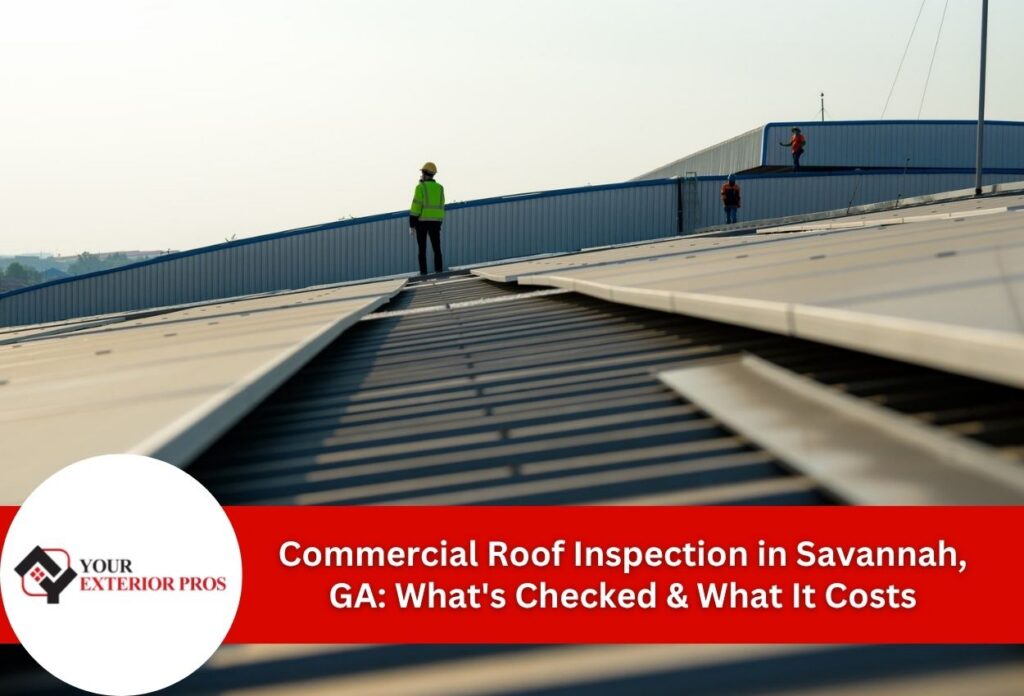

A commercial roof inspection in Savannah, GA typically costs between $300 and $900 for most standard commercial roofs, with larger or more complex structures running higher depending on roof size, type, and scale of work involved. That range covers the most common inspections on low-slope membrane roofs, metal roofs, and built-up systems across office buildings, retail strips, and warehouses throughout the area.
Savannah’s climate puts commercial roofs under constant pressure. Annual rainfall of roughly 48 to 51 inches of annual rainfall, humidity ranging from 58% to 80%, peaking during the summer, coastal salt-filled air, and Atlantic hurricane season exposure all combine to wear down roofing materials faster than inland markets. That means inspections here are not a formality: they are a direct tool for catching problems before a small seam separation or clogged drain turns into a major interior loss.
This article covers exactly what a commercial roof inspector examines, what drives inspection costs up or down, how often Savannah building owners should schedule inspections, and what to look for when hiring a qualified local roofing contractor. Whether a roof is five years old or well past the 10-year mark, knowing what to expect makes the process faster and the results more useful.
*Please note, price ranges listed in this article may not reflect the final cost of your project. Prices are subject to change based on various factors such as local labor rates, material quality, and more. All costs established in this article are rough estimates based on average industry rates.
Why Do Commercial Roof Inspections Matter More in Savannah Than in Other Markets?
Savannah’s combination of 50 to 55 inches of annual rainfall, humidity ranging from 58% to 80%, peaking during the summer, coastal salty air, Atlantic hurricane season exposure, and intense UV radiation creates roofing conditions that most inland markets never face, and those conditions stack on top of each other year-round. Each factor alone accelerates roof deterioration. Together, they compress the timeline from minor issue to serious damage in ways that catch building owners off guard.
Salt-filled air corrodes exposed metal components, flashings, fasteners, drip edges, and rooftop equipment curbs faster than in non-coastal markets. High humidity feeds algae and vegetation growth that works into seams and membrane surfaces. Ponding water left behind after heavy rainstorms add weight and holds moisture against membrane surfaces, speeding up blistering and seam separation. Most of these problems develop out of sight, under debris or at gaps and drainage details, where they stay invisible without a trained set of eyes on the roof.
Catching a failing flashing seal or blocked drain early through routine inspection can cost a few hundred dollars to correct, but waiting until water reaches interior spaces can push repair and restoration costs into the tens of thousands. That gap is the entire ROI case for regular inspections in this market.
Savannah’s building stock adds another layer of complexity. Older masonry and wood-framed historic structures in the urban core behave very differently under moisture and heat stress than newer suburban commercial buildings with lightweight steel framing and membrane assemblies. A local inspector who understands both construction types and how Savannah’s climate interacts with each brings far more practical value than a generalist contractor working from a standardized checklist. Your Exterior Pros works with both property types across the Savannah area, which shapes how inspections are approached from the first step on the roof.
What Does a Commercial Roof Inspector Look For? A Full Checklist
A qualified commercial roof inspector examines eight distinct categories of the roofing system, covering everything from the membrane surface down to interior ceiling conditions, and in Savannah, several checklist items go beyond what inspectors in inland markets routinely flag. Here is what a thorough inspection covers.
Membrane Surface & Seams
- Blistering and membrane bubbling: Inspectors look for raised areas on TPO, PVC, or EPDM surfaces that signal trapped moisture or adhesion failure common on roofs exposed to Savannah’s high UV stress and 70% to 80% humidity levels.
- Seam separation and lap joints: Every seam is checked for gaps, lifting edges, or failed welds. Wind uplift from tropical systems puts heavy stress on perimeter seams and field laps.
- Algae and biological growth: Dark streaking or surface growth on membrane material is flagged. Savannah’s warm, humid conditions make biological buildup faster here than in drier markets.
- Surface cracking and granule loss: Checked across the full field, not just obvious wear zones.
Flashings, Fasteners & Drainage
- Flashing condition at walls, edges, and terminations: Inspectors check for lifting, cracking, or failed sealant at every transition point. Salt-filled air corrosion on metal flashings and fasteners is a Savannah-specific flag that gets documented separately.
- Drip edge and perimeter edge metal: Corrosion or separation here allows wind-driven rain to enter the roof assembly, a real risk during Atlantic hurricane season.
- Drains, gutters, and scuppers: All drainage outlets are checked for debris blockage. Savannah’s 50 to 55 inches of annual rainfall means a clogged drain can create ponding water fast. Ponding water that sits for more than 48 hours after rainfall is one of the leading causes of membrane failure on low-slope roofs in this market.
- Downspout discharge and slope adequacy: The inspector evaluates whether water is actually moving off the roof or pooling in low spots.
Gaps, Equipment Curbs & Interior Indicators
- Pipe boots, vent seals, and skylight flashings: Every gap is checked for cracked sealant, open gaps, or lifted membrane edges. These are among the most common entry points for water in Savannah commercial buildings.
- HVAC curb seals and rooftop equipment surrounds: Inspectors check the seal between equipment curbs and the roof membrane, since failed curb flashing is frequently the source of interior water damage that gets misdiagnosed.
- Areas of previous repair: Patches and prior repair work are examined closely. Old repairs can mask underlying issues: a visible patch may be covering a larger seam failure or deck deterioration beneath.
- Interior ceiling staining and wet insulation indicators: A complete inspection includes walking interior spaces to match ceiling stains to roof-level findings, which helps confirm active leaks versus historic water damage.
A thorough commercial roofing inspection checklist for Savannah covers all of these categories in a single site visit. Your Exterior Pros documents findings with photos and written notes, so building owners have a clear record of current conditions and any areas that need attention before the next major rainstorm.
How Much Does a Commercial Roof Inspection Cost in Savannah, GA?
The commercial roof inspection cost in Savannah, GA typically runs between $200 and $1,500, depending on the type of inspection, roof size, and complexity, with most standard commercial roofs falling in the $350 to $700 range for a thorough on-site assessment. Knowing how much a commercial roof inspection costs in Savannah helps building owners budget accurately and avoid paying for services that do not match their actual needs.
| Inspection Type | Typical Cost Range | What’s Included | Best For |
|---|---|---|---|
| Visual Only | $200 to $350 | Surface walk, visible membrane and flashing check, drainage review, photo documentation | Newer roofs under 5 years old, pre-sale walkthroughs, and annual maintenance checks |
| Comprehensive | $350 to $700 | Full checklist: membrane, seams, gaps, flashings, equipment curbs, interior indicators | Most commercial roofs, roofs 5 to 10+ years old, roofs with prior leak history |
| Infrared / Thermal | $800 to $1,500+ | Thermal imaging to locate trapped moisture below the membrane surface, detailed moisture mapping, written report | Older roofs, suspected widespread leaks, and pre-replacement decision-making |
| Post-Storm Assessment | $300 to $900 | Wind and water damage documentation, fastener and seam inspection, insurance-ready photo report | After tropical systems, major winds, or heavy hail, any storm affecting Savannah |
Roof square footage also affects final costs. A rough planning benchmark for larger commercial roofs is $0.02 to $0.06 per square foot, useful for estimating, not as a firm quote. A 20,000-square-foot warehouse roof, for example, could reasonably land in the upper half of the full range or higher if infrared scanning is added.
Roofs over 10 years old or with a prior leak history are the strongest candidates for a full or infrared inspection. The added cost up front is far smaller than the repair bills that come from missing trapped moisture under a membrane. Your Exterior Pros provides written findings with photos so building owners have a clear record to act on.
What Factors Affect the Cost of a Commercial Roof Inspection in Savannah?
Roof size, system type, and building access are the three biggest cost drivers, but Savannah’s coastal location adds inspection complexity that can push a standard quote higher than what inland markets typically see. Most inspections fall in the $200 to $1,500 range, and understanding where your building lands helps set realistic expectations before calling a contractor.
| Cost Factor | Price Impact |
|---|---|
| Roof size and total square footage | Increases the cost, as larger surfaces take more time to walk and document |
| Roofing system type (TPO, EPDM, PVC, built-up) | Varied membrane roofs with complex seam layouts take longer than simple single-ply systems |
| Building height and access requirements | Increasing the cost of rooftop access by ladder, lift, or hatch affects labor time and safety requirements |
| Number of gaps and rooftop equipment | Increases the cost of each pipe boot, HVAC curb, skylight, and vent requires individual evaluation |
| Roof age and prior repair history | Increases the cost of older roofs and patched surfaces, which require more thorough documentation |
| Scale of inspection services requested | Varies visual-only runs $200 to $350: infrared thermal scanning runs $800 to $1,500+ |
| Savannah coastal conditions (salt-laden air, storm drainage review) | Increases cost, inspectors must evaluate corrosion on metal flashings and fasteners, wind uplift at perimeter edges, and drainage performance after heavy rainfall |
| Multi-building or portfolio pricing | Decreasing the cost of bundled inspections with a single contractor can reduce the per-building rate. |
Savannah’s coastal position means inspectors spend extra time on items that inland markets rarely prioritize. Salty air corrodes flashings, fasteners, and drip edges faster here. Wind uplift risk at perimeter seams is higher during the Atlantic hurricane season. Drainage performance after Savannah’s 50 to 55 inches of annual rainfall must be confirmed, not assumed. Each of those items adds time on the roof, and time is what drives inspection costs up.
Property management companies overseeing multiple commercial buildings can often negotiate flat-rate or bundled inspection pricing with a local roofing contractor, which can reduce the per-building cost meaningfully compared to scheduling each roof separately. If your portfolio includes three or more buildings, ask about bundle pricing before booking individual inspections.
What Are the Most Common Commercial Roofing Systems in Savannah & How Does System Type Affect Inspection?
Low-slope and flat roofing systems dominate Savannah’s commercial building stock, with TPO, EPDM, PVC, modified bitumen, built-up roofing (BUR), and metal roofing accounting for the large majority of commercial installations in the area, and each system requires a different inspection focus because each fails in different ways under Savannah’s climate conditions.
| Roofing System | Common Applications in Savannah | Key Inspection Focus Areas | Typical Lifespan | Relative Inspection Complexity |
|---|---|---|---|---|
| TPO | Retail, office buildings, light industrial | Heat-welded seam integrity, UV membrane degradation, perimeter flashings, and ponding areas | 15 to 25 years | Moderate seam failures can be subtle before leaking |
| PVC | Restaurants, facilities with chemical exhaust, and warehouses | Seam adhesion under thermal cycling, membrane brittleness, gap seals | 15 to 25 years | Moderate, similar to TPO but more rigid in heat |
| EPDM | Office parks, older commercial buildings | Blistering, shrinkage, seam adhesive failure, surface cracking at edges | 20 to 30 years | Moderate to high blistering is common in the Savannah heat |
| Modified Bitumen | Mixed-use, older retail, low-slope residential-commercial | Surface granule loss, lap seam separation, blister formation, flashing condition | 15 to 20 years | Moderate torch-applied seams require close review |
| Built-Up Roofing (BUR) | Older warehouse, industrial, and municipal buildings | Gravel loss, alligatoring surface, drainage performance, and membrane layer delamination | 20 to 30 years | High multiple layers make leaks harder to trace |
| Metal Roofing | Industrial, agricultural, and newer commercial construction | Fastener and seam corrosion from salt-filled air, panel separation, and sealant failure at gaps | 30 to 45 years | Moderate salt in the air accelerates corrosion on all metal components |
Each system responds differently to Savannah’s heat, humidity, and coastal air. TPO and PVC seams are heat-welded during installation. Prolonged UV exposure and thermal cycling can weaken those welds over time, and a failed seam may not show water inside until the damage beneath the membrane is already widespread. EPDM faces blistering pressure from Savannah’s summer heat and high humidity, while metal roofing contends with accelerated corrosion from coastal salty air that moves through the area year-round.
Knowing which system is on a building before an inspection begins allows the inspector to prioritize the right failure points first, rather than spending equal time on low-risk areas while a seam failure or blister field goes undocumented. Readers planning a roof replacement or comparing system options can find more detailed breakdowns on each type of roof in linked resources throughout this site, including our pages on commercial TPO roofing and commercial modified bitumen roofing.
How Often Should a Commercial Roof in Savannah Be Inspected?
Most commercial roofs in Savannah should be inspected at least once per year, but roofs over 10 years old or with a prior leak history need a minimum of two inspections annually, plus a check after any major storm. Frequency should increase as a roof ages because repair costs add up quickly when damage goes undetected between seasons.
| Roof Age / Condition | Recommended Frequency | Best Timing Windows |
|---|---|---|
| Under 5 years old, no leak history | Once annually | Late winter (February through March) or early fall (September through October) |
| 5 to 10 years old | Once or twice a year | Late winter and early fall, both windows if the budget allows |
| Over 10 years old or prior leak history | Twice a year minimum, plus post-storm checks | February through March and September through October, with additional checks after major weather |
| After significant weather | As needed, regardless of the regular schedule | Within 1 to 2 weeks following tropical systems, high-winds, or prolonged heavy rainfall |
The two best scheduling windows in Savannah are late winter and early fall. A February through March inspection catches any damage from winter weather and positions the roof before Atlantic hurricane season begins. A September through October inspection evaluates what summer heat, humidity, and storm activity left behind before conditions have a chance to get woerse heading into fall rain patterns.
Post-storm inspections serve a different purpose than routine ones. After a tropical system or high-winds, an inspector specifically looks for fastener pulls, seam separations, membrane punctures from wind-carried debris, flashing displacement, and clogged or overloaded drainage. Finding storm damage within 1 to 2 weeks keeps insurance documentation accurate and repair costs manageable. Delayed discovery allows water intrusion to spread under the membrane, turning a contained repair into a full replacement conversation. Your Exterior Pros schedules post-storm assessments for Savannah commercial property owners who need a documented, photo-supported report fast.
What Happens During the Inspection Process From Scheduling to Final Report?
A standard commercial roof inspection on a 10,000 to 25,000 square foot building commonly takes 1.5 to 3 hours on-site, and that time is structured, not improvised. The process moves through several distinct stages, each serving a purpose before the inspector ever sets foot on the roof.
It starts before arrival. Scheduling involves coordinating roof access, confirming whether rooftop equipment needs to be shut down, and identifying any active leak locations reported by building staff. A prepared inspector will also review prior inspection reports, existing warranty records, and any documented repair history before the site visit. That background tells the inspector where to look harder once on the roof.
What the On-Site Assessment Covers
The exterior walk begins at the perimeter. A thorough inspector walks the full roofline, checks every drain and scupper for blockage or standing water, and examines all flashings, gaps, skylights, vents, and rooftop equipment curbs individually. Membrane surfaces are checked for blistering, cracking, seam separation, and punctures. On Savannah buildings, metal components, flashings, fasteners, and drip edges get extra attention because salt-filled air accelerates corrosion faster than in inland markets.
Interior access matters too. Where ceiling space or attic areas are accessible, a qualified inspector checks for water staining, mold patterns, or daylight that points to an active breach above. Skipping the interior review means an inspector can miss active water intrusion that the membrane surface alone does not show.
What the Final Report Should Include
A professional inspection report is more than a summary. It should include dated photographs of every identified condition, a location map of deficiencies keyed to the roof layout, a severity rating for each issue, and recommended corrective actions ranked by priority. That structure allows a property owner or facilities manager to act on findings in order of urgency rather than guessing where to start.
Be cautious of any inspector who delivers only verbal findings or a one-page summary without specific locations, photos, and priority rankings attached. A verbal walkthrough is not a report: it is a conversation that disappears the moment the inspector drives away. Always request a written, photo-documented report as a standard deliverable before booking any inspection.
Are There Permit or Code Requirements for Commercial Roof Inspections in Savannah, GA?
A routine commercial roof inspection does not require a permit in Savannah, but the repair or replacement work that inspection findings trigger almost always does. That distinction matters because property owners sometimes delay follow-on repairs, assuming the same no-permit rule applies to the work itself. It does not.
Commercial roofing replacement and significant repair projects in Savannah are subject to local building code compliance and must go through the city’s inspection process. That process includes scheduled inspections tied to project milestones, certificates of occupancy where applicable, and proper project closeout documentation. Skipping the permit step on a code-required project can create problems at sale, during insurance claims, or when a tenant change triggers a certificate of occupancy review.
Inspection findings can move fast from observation to obligation. A documented membrane failure, structural deck concern, or flashing deficiency may cross the threshold from maintenance into permit-required repair territory depending on the scale of the work involved. Working with a licensed local roofing contractor who knows Savannah’s permitting process ensures that any follow-on work is properly permitted, inspected, and documented from the start rather than corrected after the fact at greater cost.
For leased commercial properties, the picture gets more layered. Inspection findings may intersect with lease terms, landlord-tenant repair responsibilities, and insurance requirements all at once. A building owner and a tenant may each have a stake in what gets documented, who authorizes repairs, and how costs are assigned. In those situations, a written, photo-documented inspection report is not just helpful: it becomes the factual record that every party references when responsibilities are disputed. Your Exterior Pros provides that level of documentation for commercial property owners and managers throughout the Savannah area.
Free vs. Paid Commercial Roof Inspections: What’s the Difference & Which Should You Choose?
A free contractor inspection works well for a basic condition check, but a paid independent inspection is the right choice any time money, legal standing, or long-term roof management is on the line. Understanding what each type actually delivers makes the decision straightforward.
Many roofing contractors in Savannah offer free inspections as part of a sales process. That is not automatically a bad thing: a reputable, established local contractor can give a property owner a genuine read on whether maintenance or repair is warranted. The limitation is structural: a free inspection is designed to identify work the contractor can sell. It may not produce the objective, documented assessment that an independent paid inspection delivers. The two serve different purposes.
- Choose a free contractor inspection if you need a basic condition assessment before deciding whether to pursue maintenance or repairs, you have no pending legal or insurance matter, and you are working with a reputable local contractor who has no incentive to exaggerate findings.
- Choose a paid independent inspection if you are purchasing a commercial property and need objective due diligence documentation before closing.
- Choose a paid independent inspection if you are involved in a litigation matter or an insurance dispute where the inspection findings may be used as evidence: a contractor with a financial stake in the outcome cannot serve as a neutral third party.
- Choose a paid independent inspection if you need to verify a warranty claim and the manufacturer or insurer requires an independent assessor’s report, not one from the contractor who installed the system.
- Choose a paid independent inspection if you want independent verification after a contractor completes repair or replacement work, confirming the scale was completed correctly before final payment.
- Choose a paid independent inspection if you are building a multi-year roof asset management plan and need an unbiased baseline report to track deterioration over time across one or more properties.
The right choice comes down to stakes: low stakes favor a free contractor inspection, while any situation involving money disputes, legal records, or major purchase decisions calls for a paid independent assessment. Your Exterior Pros provides thorough, photo-documented inspections for Savannah commercial property owners who need findings they can act on with confidence.
How Can You Reduce Commercial Roof Inspection and Maintenance Costs Over Time?
Routine preventive maintenance typically costs $0.03 to $0.10 per square foot per year, a fraction of the $3 to $8 per square foot that emergency repairs or premature replacement can run. Treating inspections as an ongoing investment rather than a one-time expense is the single most effective way to control the total cost of roof ownership over a building’s life.
| Maintenance Approach | Typical Annual Cost (10,000 sq ft roof) | Risk If Skipped |
|---|---|---|
| Twice a year inspections + minor repairs | $300 to $1,000 per year | Small issues caught early, low exposure |
| Emergency repair after delayed discovery | $2,500 to $8,000+ per storm | Water intrusion spreads before repair begins |
| Premature full replacement (neglect-driven) | $30,000 to $80,000+ one-time | 5 to 10 years of usable life lost |
The most reliable way to stay on the low end of those numbers is a documented roof asset management plan. That means a written schedule of inspections, minor repair thresholds, and condition benchmarks tracked over time with a licensed local commercial roofing contractor. A plan like this supports insurance compliance, keeps warranty terms intact, and gives facilities managers a clear record if ownership changes or a dispute arises.
Bundling inspections into a preventive maintenance agreement often lowers the per-inspection cost and locks in priority scheduling after major storms, a real advantage in Savannah’s hurricane season, when every commercial property owner in the area is calling for service at the same time. Your Exterior Pros offers maintenance agreements for Savannah commercial property owners who want consistent coverage without competing for post-storm scheduling.
How Do You Choose the Best Commercial Roofing Inspection Company in Savannah, GA?
Not all commercial roof inspectors in Savannah bring the same credentials, local experience, or report quality, and the thoroughness of the inspection report directly determines the quality of every repair, budgeting, and planning decision that follows it.
Finding the best commercial roofing inspection companies in Savannah, GA starts with a practical vetting process. Request a sample inspection report before hiring anyone. That one step reveals more about an inspector’s thoroughness than any sales conversation will. A strong report includes dated photographs, a keyed location map, severity ratings, and prioritized corrective actions. A weak report is a warning sign.
- Verify state licensing and liability insurance: Georgia does not issue a state roofing license: verify general contractor registration, general liability insurance, and any voluntary GARCA certification credentials before hiring. Uninsured contractors leave property owners exposed.
- Confirm experience with your specific roofing system: A contractor who primarily works with TPO may not have deep experience evaluating a built-up roof or modified bitumen assembly. Ask directly how many inspections they have completed on your system type.
- Ask about local coastal climate experience: Savannah’s combination of high humidity, salt-laden air, UV exposure, and hurricane-season wind-driven rain creates conditions that differ from inland markets. Inspectors without local experience may miss accelerated corrosion, algae-related membrane deterioration, or drainage failures common here.
- Require a written, photo-documented report as a standard deliverable: Verbal findings are not acceptable documentation. The report must include photographs, locations, and priority rankings, not a one-page summary.
- Check for professional certifications or manufacturer authorizations: Certifications from membrane manufacturers or industry organizations indicate training beyond the minimum. Some warranties require an authorized inspector for the documentation to be valid.
- Request references from comparable local commercial properties: A warehouse inspection differs from a medical office or retail strip center. Ask for references from property types similar to yours, and follow up.
- Look for transparent flat-rate inspection pricing: A clear, upfront cost for a defined scale of work signals professionalism. Vague pricing tied to repair recommendations is a conflict of interest worth avoiding.
Choosing the lowest-priced inspector without vetting these criteria is a false economy, and an incomplete or poorly documented report leads to missed deficiencies, incorrect repair scoping, and ultimately higher costs than a thorough inspection would have produced from the start. Your Exterior Pros delivers written, photo-documented commercial inspections for Savannah property owners who need findings they can act on and defend.
Commercial Roof Inspection vs. Full Replacement: How Do You Know Which One You Need?
A professional inspection is always the right first step: replacing a commercial roof without documented findings is a financial decision made without evidence, and replacement costs typically run $8 to $20+ per square foot or more. The inspection tells you which path is actually warranted before any money is committed.
Most property owners are surprised to learn that many suspected “replacement situations” turn out to be repairable conditions. The difference comes down to what the inspection actually finds. Localized damage is almost always a repair scenario. Widespread, recurring, or end-of-lifespan failure points toward replacement evaluation.
| Inspection Finding | Likely Recommendation | Approximate Cost Tier |
|---|---|---|
| Minor membrane punctures or surface wear in one area | Targeted repair or recoating | Low maintenance-level spend |
| Isolated flashing failure at a single gap or edge | Localized flashing repair | Low to moderate |
| Single-area ponding with no structural compromise | Drainage correction or minor repair | Moderate |
| Recurring interior leaks in multiple areas | Major repair or partial replacement evaluation | Moderate to high |
| Widespread seam failure or extensive delamination | Full replacement evaluation | High |
| Roof past design lifespan with multiple system failures | Full replacement | High $3 to $8+ per square foot |
No property owner should commit to full replacement without inspection findings that specifically support that conclusion: documented evidence protects against both under-spending and over-spending. Scheduling an inspection first gives you the facts needed to make the right call, whether that means a targeted commercial roof repair or a full commercial roof replacement budget conversation.
Ready to Schedule a Commercial Roof Inspection in Savannah, GA? Here’s Your Next Step.
A professional commercial roof inspection costs a fraction of the $3 to $8 per square foot replacement costs: it can help you avoid and in Savannah’s climate, skipping routine inspections is a risk no responsible property owner should take.
Your Exterior Pros serves commercial property owners throughout Savannah with written, photo-documented inspections, transparent flat-rate pricing, and local expertise in the coastal conditions that accelerate roof deterioration here. You get findings you can act on, defend to insurers, and use to plan repairs or budgets with confidence.
Schedule your free roof inspection.
Not ready to schedule? Learn more about commercial roof inspection services.