Annual Inspection vs. Post-Storm Inspection: Why Commercial Roofs Need Both
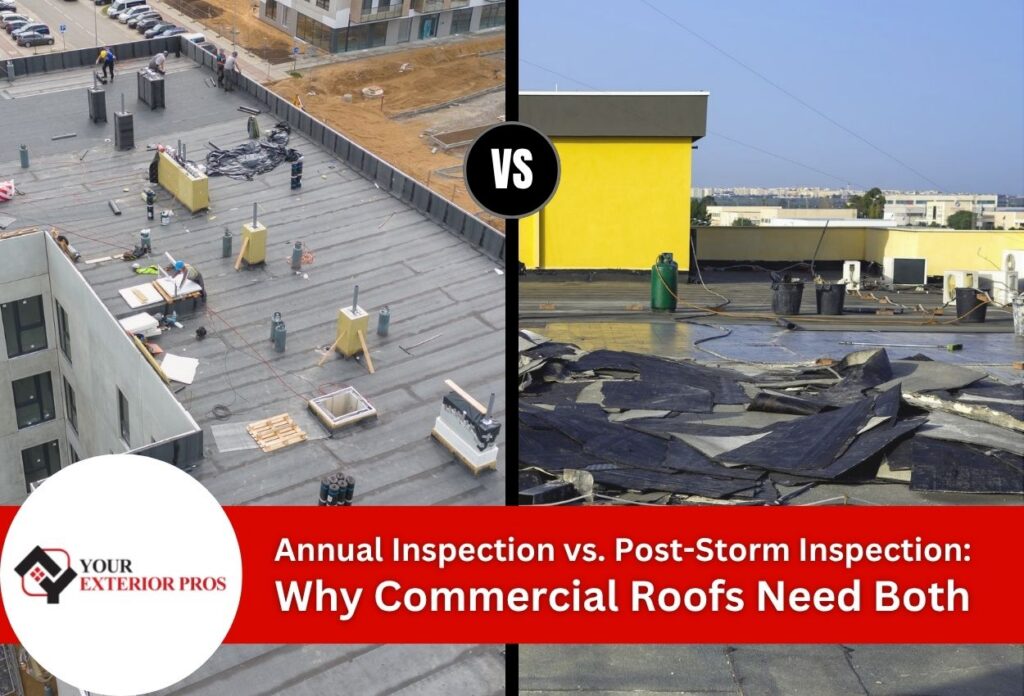

Annual inspections and post-storm inspections are not interchangeable. Annual inspections catch gradual wear before it becomes a problem, while post-storm inspections identify specific damage that happened during a storm. Skipping either one leaves gaps in your roof maintenance strategy that Savannah’s climate will eventually find and exploit.
Savannah sees roughly 49 inches of rainfall per year, with humidity levels that regularly exceed 75%. That combination creates constant pressure on commercial flat roofs, trapping moisture, causing membrane wear, and causing standing water buildup that develops slowly over months. Add in the coastal exposure to hurricanes and heavy rainstorms, and a single storm can cause damage that would never show up on a scheduled annual visit.
Both inspection types work together as part of a complete roof maintenance plan. One keeps small issues from turning into expensive repairs. The other makes sure storm damage gets found and documented fast, before leaks make the problem worse.
This guide covers what each inspection involves, when to schedule each one, how they complement each other, and what Savannah property owners should expect from a qualified commercial roofing contractor managing both.
*Please note, price ranges listed in this article may not reflect the final cost of your project. Prices are subject to change based on various factors such as local labor rates, material quality, and more. All costs established in this article are rough estimates based on average industry rates.
How Often Should a Commercial Roof Be Inspected, and Why Is That Not Enough?
Most roofing professionals recommend inspecting a commercial roof at least twice per year, once in spring and once in fall, with once-yearly inspections accepted as a minimum baseline for low-risk environments. That standard gives property owners a reasonable starting point, but it was not designed with Savannah’s climate in mind.
The twice-per-year guideline works well for inland regions with mild weather and moderate rainfall. Savannah gets roughly 49 inches of rain per year, with humidity levels that regularly exceed 75%. That kind of sustained moisture pressure is not what the standard inspection schedule was built around. Coastal climates also bring hurricane season into the picture, meaning a major storm can occur between scheduled visits and sit undetected for weeks or even months before the next inspection rolls around.
A once-yearly inspection creates a gap of up to 12 months where storm damage, membrane separation, or leaks can quietly make it worse without anyone catching it. In a drier climate, that gap may be manageable. In Savannah, it is not. Heavy rain can exploit a small seam failure in days. High humidity keeps trapped moisture active inside a roofing system long after a storm passes.
This is why the question of how often a commercial roof should be inspected does not have a single answer that fits every property or every climate zone. Flat roofs in coastal Georgia face conditions that demand a more aggressive schedule than the national baseline recommends. The right frequency depends on roof age, membrane type, recent weather history, and how close the building sits to the coast, factors that vary widely from one Savannah property to the next.
What Is a Routine Annual Commercial Roof Inspection and What Does It Actually Cover?
A routine annual commercial roof inspection is a scheduled, systematic evaluation of your entire roofing system, membrane surface, drainage, flashing, gaps, and interior moisture signs designed to catch slow-developing problems before they turn into failures. It is not a quick visual check. A thorough annual inspection examines every part of the roof that accumulates wear between storms.
- Membrane surface condition: Inspectors look for UV degradation, blistering, cracking, and surface erosion. In Savannah’s heat, membrane surfaces can show measurable wear after just 1 to 2 summers of direct sun exposure combined with sustained humidity above 75%.
- Seam integrity: Seams are where flat roof membranes are most likely to separate first. Inspectors check for lifted edges, widening gaps, and early-stage separation that has not yet caused a visible leak but will often within 1 to 2 rain cycles.
- Ponding water risk zones: Standing water that remains on a flat roof for more than 48 hours after rainfall accelerates membrane breakdown. Annual inspections map low spots and drainage problem areas where ponding is most likely to form.
- Flashing around HVAC units and gaps: Every pipe, vent, conduit, and rooftop unit creates a potential entry point for water. Inspectors check that flashing seals remain tight and have not pulled away from the membrane surface due to thermal movement.
- Parapet walls and coping: Parapet walls take direct wind and rain exposure. Cracks in the coping or wall surface allow water to enter laterally, a failure point that is easy to miss without a dedicated inspection.
- Gutters and drainage systems: Blocked or slow-draining gutters force water to back up onto the surface of the roof. Inspectors confirm that all drainage paths are clear and functioning the way the roof was designed to drain.
- Interior moisture signs: Water stains on ceiling tiles, soft spots in insulation, and mold growth inside the building are often the first visible signs that a roof membrane has already been breached, sometimes for months before the leak appears inside.
- Insulation performance: Saturated insulation loses its R-value and adds weight to the roof deck. Annual inspections include moisture scanning or core sampling when surface conditions suggest water has leaked below the membrane.
Annual inspections are built to find problems that develop gradually, such as thermal expansion cracking, UV degradation, leaks, and progressive seam separation, not damage caused by a single storm. In Savannah, where heat and humidity accelerate membrane wear faster than in drier markets, the findings from an annual inspection are more time-sensitive, and acting on them quickly matters more. Conditions that might stay manageable for 12 months in a mild inland climate can get worse in a matter of weeks here.
What Does a Post-Storm Commercial Roof Inspection Include and How Is It Different?
A post-storm commercial roof inspection targets weather-specific damage from wind uplift at seams, debris punctures, displaced flashing, and leaks that happened during a single storm rather than the gradual wear a routine annual inspection is designed to find. The scale is narrower, the urgency is higher, and the approach is fundamentally different.
In Savannah’s coastal climate, post-storm inspections carry an added layer of complexity. Tropical weather and hurricanes drive rain horizontally at high speed, forcing water under membrane edges and into roof-to-wall transitions in ways that standard inspection checklists do not address. That kind of wind-driven rain may leave no visible interior symptoms for days or even weeks, which is exactly why post-storm inspections must happen fast, before trapped moisture spreads deeper into the roofing system.
| Inspection Category | Routine Annual Inspection | Post-Storm Inspection |
|---|---|---|
| Purpose | Catch gradual wear, membrane aging, and slow moisture buildup | Identify acute damage caused by a specific storm |
| Timing trigger | Scheduled typically once or twice per year | Event-driven within 24 to 72 hours after a major storm |
| Primary focus areas | Seam wear, UV degradation, ponding zones, flashing condition | Wind uplift at seams and membrane edges, debris punctures, displaced flashing, blocked drains |
| Inspection depth | Full roofing system surface, drainage, insulation, interior signs | Targeted to storm impact zones, plus roof-to-wall transitions and structural stress points |
| Documentation type | Condition report with maintenance recommendations and timeline | Damage assessment with photos, mapped leak points, and insurance-ready documentation |
| Urgency of findings | Most findings allow time for scheduled repairs | High unaddressed storm damage can get worse within days in Savannah’s humidity. |
Post-storm inspectors in Savannah also map interior leaks separately from visible surface damage, because what shows up on the membrane does not always match where water has traveled inside the roof assembly. Wind-driven rain can leak under a membrane’s edges during tropical weather, which is one of the most common failure modes in coastal markets, and it will not appear on a standard annual inspection checklist. If a named storm or significant windstorm has hit the area, schedule a post-storm inspection within 72 hours, before any temporary repairs are made, to ensure documentation is complete for insurance claims and contractor scale-of-work review.
What Are the Most Common Signs of Commercial Roof Damage After Severe Weather in Savannah?
After severe weather in Savannah, the most telling signs of commercial roof damage fall into two categories: exterior damage visible only from on-roof assessment, and interior warning signs that show up inside the building. Facility staff walking the parking lot after a storm will miss most of them.
Exterior Signs Visible Only From On-Roof Assessment
- Membrane tears and punctures: Wind-driven debris during coastal storms can pierce flat roof membranes in spots that look minor from below but allow water in immediately. A tear as small as a few inches can let in enough moisture to saturate the insulation layer beneath within 24 to 48 hours.
- Lifted or separated flashing: Flashing around HVAC units, pipe gaps, and parapet walls is the most common failure point after high winds. Coastal wind uplift along Savannah’s corridors pulls flashing away from the membrane at seams that were already under thermal stress.
- Displaced edge metal: Edge metal and drip edge sections can shift or pull away entirely when wind speeds climb. Once edge metal is displaced, water tracks directly into the roof assembly at the building perimeter, one of the most damaging entry points on a flat roof.
- Debris accumulation over drains: Heavy rain deposits branches, gravel, and debris directly over roof drains, blocking the drainage paths the roof was designed to use. Standing water that sits for more than 48 hours after rainfall accelerates membrane breakdown and adds structural weight.
- Blistering or bubbling membrane: Post-storm heat and trapped moisture cause membrane surfaces to blister and bubble, especially on TPO and EPDM systems. In Savannah’s humidity, which regularly exceeds 75%, these blisters can develop within days of a storm rather than weeks.
Interior Warning Signs That Indicate a Breach Has Already Occurred
- Ceiling stains and water streaks: Brown or yellow staining on ceiling tiles is a sign that water has already passed through the membrane, the insulation layer, and the roof deck. By the time a stain appears, the breach has typically been active for days or longer.
- Damp or compressed insulation: Saturated insulation loses its R-value and adds dead weight to the roofing system. It rarely dries out on its own in Savannah’s climate and typically requires replacement once wet.
- Mold odor inside the building: Savannah’s sustained humidity means a small breach can trigger mold growth inside the roof assembly within days, not weeks. A musty smell after a storm is a strong indicator that moisture is already trapped and active.
- Bubbling or peeling paint on ceilings or upper walls: Paint bubbling near roof-to-wall transition points points to wind-driven rain, a pattern common in coastal markets during tropical storms.
- Wet or discolored fixtures near the ceiling: Moisture reaching electrical fixtures, light housing units, or conduit runs near the roofline signals that water has traveled well beyond the initial point of entry and should be treated as an urgent safety concern.
Most of these indicators are invisible from ground level. A facilities manager doing a post-storm walkthrough around the building exterior will not spot lifted flashing, membrane tears, or blocked drains without physically accessing the surface of the roof. In Savannah’s coastal climate, where humidity turns a small breach into active mold growth within days, a formal on-roof inspection within 72 hours of a major storm is not optional: it is the only way to catch damage before it spreads deeper into the building.
What Is the Difference Between Routine and Emergency Roof Inspections, and Does Urgency Change What’s Inspected?
There are 3 distinct inspection types used for commercial roofs: emergency triage, post-storm assessment, and routine scheduled inspection, and each one examines different things in a different order. Urgency does not just affect timing. It changes what gets inspected first, how deep the scale goes, and what documentation gets produced.
| Inspection Category | Emergency Triage Inspection | Post-Storm Damage Assessment | Routine Scheduled Inspection |
|---|---|---|---|
| Triggering storm | Active leak or visible structural breach in progress | Named storm, high winds, or heavy rain | Calendar-based: no storm required |
| Response timeframe | Same day, within hours of the reported breach | Within 24 to 72 hours after the storm | Once or twice per year on a set schedule |
| Inspection scale | Focus on the active entry point only, stop the immediate damage | Full storm-impact assessment: membrane, flashing, drains, edges, interior leaks | Full roofing system: surface wear, seams, drainage, insulation, interior signs |
| Documentation output | Field notes and emergency repair record: a basic written log | Damage report with photos, mapped leak points, and insurance-ready documentation | Condition report with maintenance recommendations and repair timeline |
| Insurance relevance | Low emergency triage alone rarely satisfies a claim requirement | High Georgia insurers typically require a documented assessment completed within a defined window after the storm | Moderate supports ongoing maintenance records but not storm-specific claims |
| Typical next steps | Temporary tarping or an emergency patch: a full assessment follows once conditions are safe. | Submit documentation to the insurer: schedule permanent repairs based on mapped damage. | Schedule repairs based on condition ratings: update inspection log |
Emergency triage stops active damage: it is not a substitute for a full assessment. Once the immediate breach is contained and conditions are safe, a complete post-storm inspection must follow to document everything an insurer needs. For commercial roof storm damage claims in Georgia, a documented post-storm inspection completed within 24 to 72 hours of the storm is often a requirement: missing that window can put the entire claim at risk. Routine inspections run deeper than either urgent type because there is no time pressure, allowing inspectors to scan for slow moisture buildup, UV degradation, and seam wear that storm-driven inspections are not designed to catch.
How Do Savannah’s Weather Patterns Make Both Inspection Types Non-Negotiable?
Savannah’s hurricane season runs from June through November, 6 months of the year when any commercial roof without a documented pre-season inspection is already behind. With annual rainfall averaging around 49 inches and humidity that regularly exceeds 75%, the climate does not offer a forgiving window between storms. Skipping either inspection type is not a scheduling shortcut. It is a direct path to preventable structural failure.
The Pre-Season Inspection Calendar Every Savannah Property Owner Needs
The most reliable time to schedule an annual inspection in Savannah is late winter or early spring before hurricane season opens in June. This window gives property owners time to identify and repair existing membrane wear, failed seams, or drainage problems while the weather is still cooperative. A roof that enters June with unresolved damage from the previous season is already weakened before the first storm arrives. Scheduling the annual inspection in February or March allows repairs to be completed and documented before the highest-risk months begin. That timing also protects insurance records. Insurers in coastal markets want to see that maintenance was performed before a claim, not after.
Why Waiting for the Next Annual Inspection After a Storm Is a High-Risk Strategy
In most climates, a minor membrane breach might stay minor for weeks. In Savannah, it will not. Humidity above 75% means that moisture that enters the roof assembly after a storm stays trapped. It does not dry out between rainstorms. Mold can begin developing inside a roof assembly within days under these conditions, not weeks. Waiting until the next scheduled annual inspection after a significant storm could mean 3, 6, or even 12 months of active moisture damage working through insulation and into structural components before anyone looks.
Thermal expansion adds another layer of risk. During Savannah’s summer heat cycles, flat roof membranes, particularly TPO and EPDM systems, expand and contract repeatedly, which can cause cracking along seams and at flashing transitions. A membrane already stressed by heat cycles is more vulnerable when a storm hits. Wind-driven rain then exploits those weakened points in ways that are not visible from the ground. A post-storm inspection catches the combination of heat damage and storm impact. An annual inspection alone, scheduled months earlier, would have no record of what the storm did to an already-stressed membrane. Only both inspection types, working together in sequence, document the full picture, and that documentation is what protects the property owner during the repair and claims process.
What Should Be on Your Commercial Roof Inspection Checklist After Storm Damage?
A complete post-storm commercial roof inspection covers at least 8 distinct areas, and skipping any one of them can leave damage undocumented and an insurance claim unsupported. The sequence matters as much as the checklist itself. Start with safety, work outward across the surface, then move inward to document what the storm pushed through the membrane and into the building below.
| Inspection Item | What to Look For |
|---|---|
| 1. Safety assessment (before accessing the roof) | Standing water, soft or spongy roof deck areas, displaced equipment, downed electrical lines near the roofline |
| 2. Membrane surface’s structural integrity | Tears, punctures, blistering, or missing sections: wind-lifted membrane edges: hail impact marks on TPO, EPDM, or modified bitumen surfaces |
| 3. Seam and edge conditions | Separated or lifted seams along laps: pulled-away termination bar at the roof perimeter: edge metal displacement |
| 4. Flashing and counter-flashing | Lifted, bent, or missing flashing at walls and transitions: separation between counter-flashing and the wall surface: cracked sealant at all termination points |
| 5. Roof gaps (HVAC, vents, drains) | Cracked or missing pitch pans, lifted pipe boots, debris blockage inside drain bowls, separated membrane at curb edges around rooftop units |
| 6. Parapet walls and coping | Displaced or cracked coping caps, open mortar joints, and leak paths at parapet-to-membrane transitions |
| 7. Interior ceiling and roof deck condition | New or expanding ceiling stains, wet insulation above ceiling tiles, mold odor, and moisture near electrical fixtures are all signs that water has already moved through the roof assembly |
| 8. Drainage system status | Blocked or slow-draining interior drains and scuppers: ponding water remaining 48+ hours after the storm ended: debris accumulation at drain edges |
| 9. Photographic documentation | Timestamped photos of every damaged area: wide-angle shots establishing location on the roof, close-up shots of specific damage, photos of interior leak signs tied to exterior breach locations |
Documentation is not a formality: it is financial protection. Georgia insurers typically require timestamped photos, a contractor-signed inspection report, and material identification sufficient to support a replacement estimate. Photos without professional sign-off rarely satisfy a commercial claim. A contractor-documented inspection report maps each breach point, identifies the membrane system involved, and ties exterior damage to interior leaks, giving the insurer exactly what the claim review process requires.
Note that specific checklist items vary depending on the roofing system in place. A TPO membrane fails differently at seams than EPDM or modified bitumen does, and built-up roofing shows storm damage in ways that single-ply systems do not. The checklist above covers the framework, and a separate review of post-storm inspection steps organized by roofing system type gives inspectors and property owners a more targeted starting point for each material category. Your Exterior Pros can confirm which items apply to your specific system before the inspection begins.
How Do Annual and Post-Storm Inspections Work Together to Extend Commercial Roof Lifespan?
Annual inspections and post-storm inspections serve different functions, and a commercial roof needs both to reach its full lifespan. Annual inspections establish a documented baseline of the roof’s condition over time, tracking slow degradation like UV wear, seam fatigue, and membrane thinning. Post-storm inspections capture acute damage that happens between those annual visits. Neither type replaces the other.
How Cumulative Undetected Damage Shortens Roof Life
Every missed post-storm inspection allows incremental damage to build. A small membrane breach that forms after a hurricane or heavy coastal storm does not stay small in Savannah’s climate. Humidity that regularly exceeds 75% keeps moisture trapped inside the roof assembly.
Over months, that trapped moisture works through insulation layers and into the structural roof deck below. What starts as a repair that might cost a few hundred dollars can add up to a full roof replacement if left undetected across 2 or 3 storm cycles. Both inspection types are cost-avoidance tools: they protect the capital investment in the building by catching problems before the damage adds up.
How Annual Records Strengthen Post-Storm Insurance Claims
Documented annual inspection records do more than track roof condition: they establish a pre-storm baseline that Georgia insurers use to evaluate commercial claims. When a post-storm inspection report references a previous annual inspection showing the membrane was in sound condition before the storm, it removes the insurer’s ability to classify new damage as pre-existing wear. Without that baseline documentation, the burden falls on the property owner to prove the storm caused the damage.
There is also a warranty dimension that many property owners overlook. Manufacturers include inspection and maintenance documentation requirements in their commercial roofing warranties. Gaps in inspection records, even a single missed annual cycle, can void that coverage entirely. That means a property owner could face a full replacement cost with no warranty offset and no insurance recovery, simply because the paperwork was not kept current. Running both inspection types consistently and keeping the records is what keeps all three layers of financial protection intact: the warranty, the insurance claim, and the roof itself.
What Does It Cost to Skip One and What Is the ROI of Doing Both?
A routine commercial roof inspection typically costs a fraction of what a single undetected storm breach will cost to remediate. In many cases, the gap between inspection costs and repair costs runs 10x to 50x or more. The table below shows where that gap appears across the most common cost scenarios.
| Cost Scenario | Typical Cost Range | What Drives the Cost |
|---|---|---|
| Routine annual inspection | $300 to $600 | Scheduled surface review, drainage check, and documentation report |
| Post-storm inspection | $300 to $700 | Targeted damage assessment, timestamped photos, contractor-signed report for insurance |
| Minor storm damage repair (caught early) | $500 to $2,500 | Seam re-sealing, small membrane patch, flashing reattachment at 1 or 2 breach points |
| Major membrane replacement driven by undetected damage | $8,000 to $30,000+ | Full or partial membrane replacement after moisture has saturated insulation layers and reached the structural roof deck |
| Interior water damage remediation from a missed inspection | $5,000 to $50,000+ | Ceiling replacement, mold abatement, damaged inventory or equipment, structural repairs, business interruption |
The math is straightforward. Spending $600 to $1,300 per year on both inspection types is the lowest-cost line item in any commercial building maintenance budget, and it protects against the highest-cost outcomes. Interior water damage that results from a missed post-storm inspection can cost more than a decade of combined annual and post-storm inspections. Early detection is not just the smart call: it is the financially defensible one.
Post-storm inspections carry an added financial dimension that annual inspections alone cannot provide. A documented, contractor-signed inspection report completed quickly after a storm is frequently the difference between a covered commercial insurance claim and a denied one. Insurers have a clear path to deny claims when no inspection record exists: they can attribute damage to pre-existing wear rather than to the storm. A professional report with timestamped photos, material identification, and tied interior-to-exterior breach documentation removes that argument entirely. In storm-exposed markets, that report often recovers far more in claim value than the inspection itself costs.
How Should Commercial Property Owners in Savannah Schedule and Budget for Both Inspection Types?
Schedule the annual inspection in late winter or early spring before hurricane season begins on June 1, and treat post-storm inspections as a separate triggered response, not a substitute for the annual visit. These are two different planning events that require two separate budget allocations.
Step-by-Step Planning Guide
- Set the annual inspection date for February or March. This gives enough time to complete repairs before the Atlantic hurricane season opens. Savannah’s coastal exposure means a roof that enters June with unresolved seam fatigue or drainage issues is already at risk.
- Define your post-storm trigger criteria in advance. Do not wait until after a storm to decide whether an inspection is needed. Set clear thresholds now listed in the trigger checklist below so the decision is automatic when weather events occur.
- Select a qualified Georgia-licensed roofing contractor before you need one. Georgia contractor licensing, manufacturer certifications, familiarity with Savannah city permit processes, and verified general liability and workers’ compensation insurance are all non-negotiable requirements. A contractor without documented coastal climate experience may miss failure patterns specific to Savannah’s humidity and storm exposure.
- Budget both inspection types as fixed annual line items. Based on typical costs in the prior content, budget $300 to $600 for the annual inspection and set aside $300 to $700 as a contingency for one post-storm assessment per year. That totals $600 to $1,300 annually, a fraction of the $8,000 to $30,000+ cost of a membrane replacement driven by undetected damage.
Post-Storm Inspection Trigger Checklist
Use this Yes/No list after any storm. Answer “Yes” to any item and schedule a professional inspection within 48 hours.
- Did a named storm or tropical system pass within 50 miles? Yes inspect. No, proceed to the next item.
- Sustained winds exceeded 50 mph, or gusts exceeded 70 mph? Yes inspect. No, proceed to the next item.
- Hailstones measured 1 inch or larger? Yes inspect. No, proceed to the next item.
- Any visible exterior damage to walls, windows, or signage? Yes inspect. No, proceed to the next item.
- New ceiling stains, mold odor, or wet tiles visible inside the building? Yes, inspect immediately. No routine monitoring is sufficient until the next scheduled annual visit.
- The last professional inspection was more than 10 months ago. Yes, combine the post-storm review with the annual inspection cycle rather than waiting further.
Property owners who build this framework into their facility maintenance calendar before storm season starts are the ones who avoid scrambling for a contractor after a major storm when qualified crews are in high demand across the region. For deeper guidance on what to look for when selecting a contractor for either inspection type, a dedicated review of how to choose a commercial roofing contractor in Savannah, GA covers contractor vetting in full detail.
What Qualifications Should You Require From a Commercial Roof Inspector in Savannah?
Any commercial roof inspector working in Georgia must hold an active Georgia contractor license: this is the legal baseline, not an optional credential. Beyond licensing, require current general liability insurance, workers’ compensation coverage, OSHA fall protection compliance, and manufacturer certifications matched to your specific roofing system. A contractor certified by a manufacturer understands the exact warranty documentation requirements for those systems, and their inspection reports carry more weight with both insurers and manufacturers when a claim or warranty dispute arises.
| Qualification | Why It Matters for Inspection Quality |
|---|---|
| Active Georgia contractor license | Legal requirement to perform roofing work in the state: unlicensed contractors void most warranties on contact |
| General liability and workers’ compensation insurance | Protects the property owner from financial liability if a worker is injured on-site during the inspection |
| Manufacturer certification | Ensures the inspector knows the warranty terms and maintenance documentation standards for your specific roofing system |
| Local Savannah experience | Coastal humidity, storm exposure, and ponding patterns require familiarity that inspectors from outside the region may lack |
| OSHA fall protection compliance | Applies to inspection work as well as installation: property owners share responsibility for ensuring roof access is granted only to compliant contractors |
| Written inspection report with photos | Timestamped, documented reports are what Georgia insurers and manufacturers require to process claims and validate warranty coverage |
| Maintenance plan offerings | Contractors who offer ongoing maintenance plans are invested in long-term roof performance, not just a one-time visit. |
Granting roof access to a contractor who cannot verify these qualifications puts both the building and its warranty at risk. Your Exterior Pros meets all of these standards and serves commercial property owners throughout the Savannah area with documented, manufacturer-aligned inspection reports.
Annual vs. Post-Storm Inspections: A Side-by-Side Summary for Facility Managers
These two inspection types serve different purposes, run on different schedules, and protect different interests: treating them as interchangeable is one of the costliest planning mistakes a facility manager can make.
| Decision Factor | Annual Inspection | Post-Storm Inspection |
|---|---|---|
| Purpose | Detect wear, aging, and slow-developing deterioration before failure | Identify storm-caused damage quickly for repair and insurance documentation |
| Frequency | 1 time per year | As needed, triggered by a qualifying storm |
| Timing Trigger | Scheduled for late winter or early spring, before June 1 | Event-driven within 48 hours of a qualifying storm |
| SJob cale | Full roofing system: membrane, seams, flashings, drainage, gaps, interior indicators | Focused on impact zones, wind uplift areas, displaced flashings, and new breach points |
| Documentation output | Written condition report with photos, maintenance recommendations, and repair priority list | Timestamped contractor-signed report with storm-specific damage photos and breach mapping |
| Insurance relevance | Supports proof of maintenance history: reduces claim denial risk | A direct report is required evidence for a storm damage insurance claim |
| Warranty relevance | Required by most manufacturers to keep workmanship and material warranties active | Document storm-caused damage as distinct from wear, protecting warranty standing |
| Typical cost range | $300 to $600 | $300 to $700 |
| Recommended action if findings are identified | Schedule repairs before hurricane season: prioritize drainage and seam issues | File insurance claim quickly: complete emergency repairs within days, not weeks |
Use this table as a reference when presenting the inspection strategy to building owners, stakeholders, or internal maintenance teams. It frames both inspection types as budget line items with defined triggers, outputs, and outcomes, not vague maintenance tasks. Annual and post-storm inspections are not competing options: together, they cost $600 to $1,300 per year and protect against repairs that can reach $8,000 to $30,000+ or more. Neither type substitutes for the other one tracks long-term roof health, and the other responds to sudden issues. A complete protection strategy requires both.
Ready to Schedule Your Commercial Roof Inspection in Savannah? Here’s How to Get Started.
Avoiding an $8,000 to $30,000+ membrane replacement starts with a $300 to $600 annual inspection, and with hurricane season running June through November, there is no safe window to delay. Savannah’s year-round storm risk means a post-storm assessment can become necessary any month of the year.
Your Exterior Pros works with commercial property owners throughout Savannah, GA, on both annual inspections and post-storm assessments, along with maintenance plans that cover both. The right time to schedule is before a storm forces the decision for you.
Schedule your free roof inspection.
Not ready to schedule? Learn more about commercial roof inspections in Savannah.